

Question
Now that Vibrio pectenicida FHCF-3 has been named as a causative agent of sea star wasting disease (Prentice et al. 2025), is there enough public sequence data to find it as “contamination” in sea star datasets that were never meant to look for it?
Short answer: yes. The approach has been done before in a narrow way. Hewson 2025 BLASTed one 16S copy against 2013 to 2015 viromes and transcriptomes. This screen covers every Asteroidea run in SRA instead and uses NCBI’s own per-run read classifications (STAT).
What is in SRA
Pulled run info for txid7588[Organism:exp] (Asteroidea) from NCBI E-utilities on 11-28-2026.
| Experiments / runs | 4,668 / ~4,680 |
| BioProjects | 179 |
| Total bases | ~30 Tb |
| RAD-seq / WGS / RNA-seq | 1,916 / 1,200 / 1,027 |
| Metagenomic + metatranscriptomic | 165 |
| Top species | Pisaster ochraceus 1,196, Acanthaster ~1,190, Patiria miniata 502, Pycnopodia helianthoides 263 |
RAD-seq and amplicon libraries are not useful here, which leaves roughly 2,500 informative runs.
STAT pass in BigQuery
The query takes every run in those 179 BioProjects. It also adds any run whose STAT profile contains at least 1,000 Asteroidea reads, which catches sea star material labelled “metagenome”. It then pulls STAT counts for Bacteria, Vibrionaceae, Vibrio and V. pectenicida.
- Query: asteroidea_vibrio_STAT.sql
- Full output, 15,747 runs: asteroidea_STAT_results.csv
- Runs with 10 or more V. pectenicida reads, 499: vpectenicida_STAT_positives.csv
The “contains Asteroidea” clause turned out to be generous. It pulled in about 6,200 extra runs (sea cucumber, abalone, krill, lots of marine metagenomes). 3,227 runs have no STAT record, mostly bisulfite-seq.
The positive control gives a fingerprint
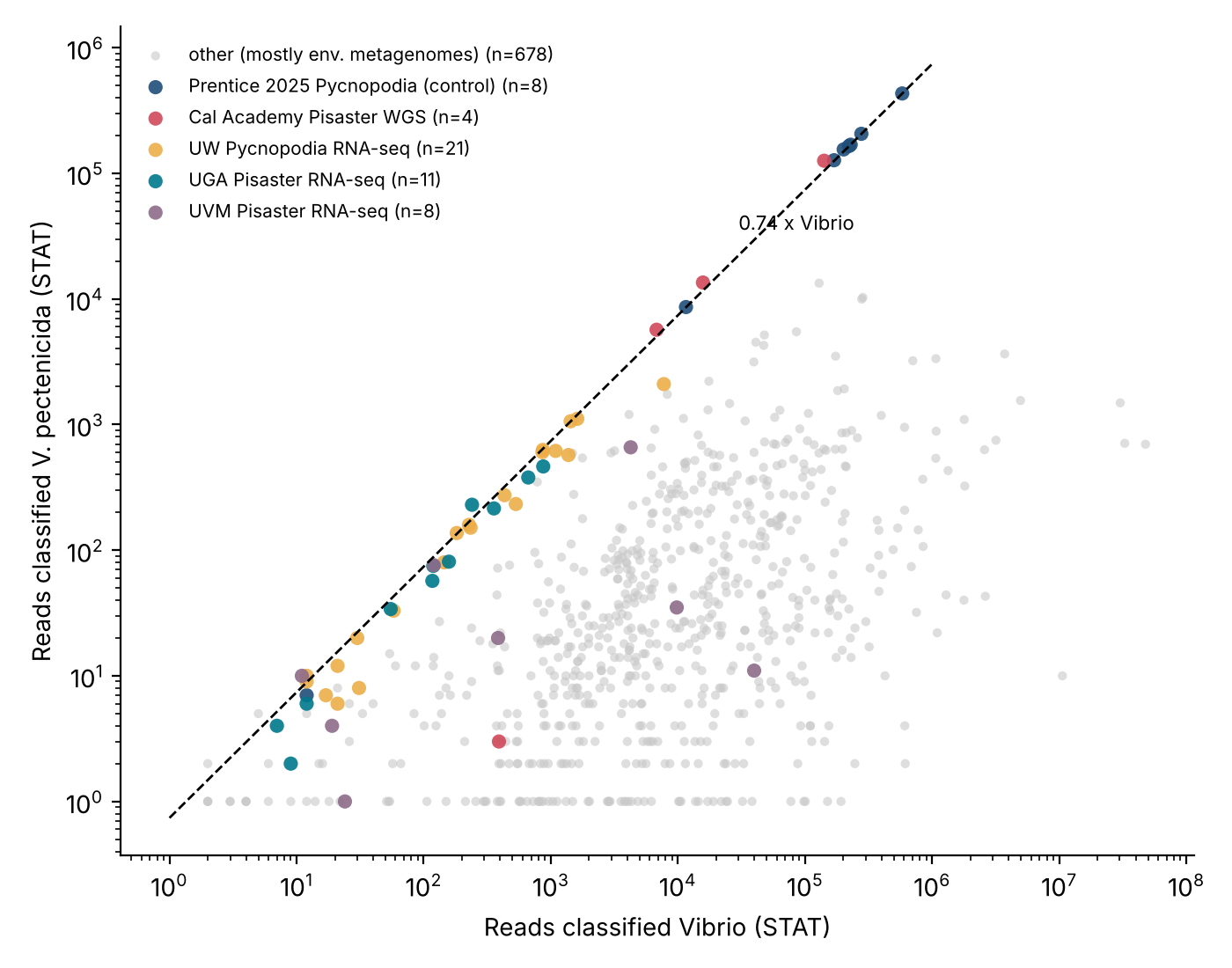
In the Prentice coelomic fluid metatranscriptomes (PRJNA1195080), 7 of 28 runs are strongly positive, with 8,600 to 432,000 V. pectenicida reads. In every one, STAT calls about 0.74 of the Vibrio reads as V. pectenicida. That ratio is a useful fingerprint. A run near the line probably has an FHCF-like genome in it. Runs well below it are other Vibrios that happen to share sequence with V. pectenicida.
Hits
| BioProject | Data | Positive (≥10 reads) | Signal |
|---|---|---|---|
| PRJNA1195080 | Prentice Pycnopodia metatranscriptomes | 7 / 28 | 8.6k to 432k reads, fraction ~0.74 (control) |
| PRJNA1550192 | Cal Academy Pisaster WGS (yellow and red samples, 2024-10-03) | 3 / 4 | 5.7k to 126k reads, fraction 0.84 to 0.89 |
| PRJNA1440140 | Crandall (Roberts Lab) Pycnopodia coelomocyte RNA-seq, poly-A, lab challenges 2021 and 2022 | 17 / 28 | 10 to 2,100 reads; all 14 exposed animals positive (see below) |
| PRJNA1116313 | UGA Pisaster RNA-seq, 2025 | 8 / 89 | 34 to 464 reads, fraction 0.5 to 0.96 |
| PRJNA934423 | UVM Pisaster RNA-seq, 2023 | 6 / 93 | mostly low fraction, likely cross-hits |
The Cal Academy Pisaster WGS is the surprise. It is a second host species, the data is total DNA, and one sample carries about 126k reads. That is probably enough to get decent coverage of the genome.
Nothing in the 2015 Pycnopodia RNA-seq (PRJNA270176, treated or control). Nothing meaningful in the Vermont Pycnopodia metagenomes (one 12-read hit), and only 15 reads in the one Cornell virome that made it in.
Of the environmental metagenomes, 454 runs have V. pectenicida calls, but nearly all sit well below the line. The one to look at is a 2016 J. Craig Venter Institute marine metagenome (PRJNA320636), with a fraction around 0.5 and about 1,100 reads.
PRJNA1440140: exposed vs control
PRJNA1440140 is Grace Crandall’s work here in the lab, “Genome-Resolved Antibacterial Immune Response Conserved in Juvenile and Adult Sunflower Sea Stars”, submitted 2026-03-19. Grace is also an author on Prentice et al. 2025. It is poly-A coelomocyte RNA-seq from two lab SSWD challenge experiments: adults in October 2021, and adults plus juveniles in July 2022. Treatment comes from the BioSample attributes.
| Year | Treatment | Runs | ≥10 reads | Median V. pectenicida reads | Max |
|---|---|---|---|---|---|
| 2021 | Exposed | 8 | 8 | 439 | 1,111 |
| 2021 | Control | 8 | 3 | 8 | 20 |
| 2022 | Exposed | 6 | 6 | 403 | 2,099 |
| 2022 | Control | 6 | 0 | 0 | 8 |
Every exposed animal carries the signal, and among exposed animals the fraction of Vibrio reads called V. pectenicida is 0.55 to 0.75, close to the Prentice 0.74. Controls top out at 20 reads. This is the cleanest result in the screen. It comes from libraries built for a different question (host immune response), from poly-A libraries that should have depleted bacteria, and from challenges run before FHCF-3 was isolated in February 2024. The 9 to 20 reads in three 2021 controls could be index cross-talk or real low-level presence; read mapping should sort that out.
Per-run table: PRJNA1440140_treatment_vpec.csv
Caveats
- STAT cannot separate FHCF-3 from other V. pectenicida strains.
- Poly-A RNA-seq is depleted for bacteria, so finding no reads does not mean the bacterium was absent.
- STAT has not been run on every run, especially the newest ones.
- The disease state of the Cal Academy Pisaster samples is not in the sample names. Check the BioSamples or ask the submitters.
Next
- Map the 34 high-fraction runs, plus the Prentice negatives as controls, against the FHCF-3 genome (JBLZMR000000000) and a panel of related Vibrio genomes. Look at coverage breadth and at the three aerolysin-like toxin genes.
- Start with the Cal Academy Pisaster runs and try strain-level variant calls against FHCF-3.
- Pull the Hewson-era viromes directly by BioProject. They are labelled “viral metagenome” and were mostly missed by the organism filter.