

Why
There are three Ostrea chilensis genome files floating around this project: the two haplotype assemblies from the annotation contract (Och_HapA, Och_HapB) and a merged “Assembly 1.0” (merged_out.fasta.TBtools.fa) that has been the de facto alignment target for the ONT RNA-seq work. Nobody had written down how they actually relate to each other, and I need to pick a reference and defend the choice. So: align all three against each other and look.
Code is code/12-compare-genomes.py, outputs in output/12-compare-genomes/.
The script
One standard-library Python file — no pandas, no matplotlib. It downloads the FASTAs, summarizes them, runs three minimap2 comparisons, parses the PAFs, and hand-writes SVG dot plots.
python code/12-compare-genomes.py --threads 16A few choices worth flagging:
Download the .fai first. Each assembly’s index is a few hundred bytes and carries every sequence name and length, which is all the stats table needs. That makes --stats-only a free, network-cheap mode:
python code/12-compare-genomes.py --stats-onlyUse the .fai to detect a truncated download. These are 0.8–1.2 GB files over HTTP, and a half-finished FASTA is the kind of thing that quietly poisons an alignment. The last FAI record says where the last sequence starts and how it’s wrapped, so you can compute the minimum legal file size and refuse to proceed:
minimum_bytes = (
    offset
    + ((length - 1) // line_bases) * line_width
    + ((length - 1) % line_bases)
    + 1
)
Downloads go to a .part file, resume with curl --continue-at -, and only get renamed into place on success. Same pattern for the PAFs.
Stream minimap2 straight into gzip. No intermediate plain-text PAF on disk:
process = subprocess.Popen(command, stdout=subprocess.PIPE, stderr=log_handle)
with gzip.open(temporary, "wb", compresslevel=6) as paf_handle:
    shutil.copyfileobj(process.stdout, paf_handle, length=1024 * 1024)
Coverage is computed on merged intervals. Summing PAF block lengths double-counts anywhere two alignments overlap the same locus, which in a haplotype-vs-haplotype comparison is everywhere. merge_interval_length() collapses overlapping intervals per sequence first, so “aligned bp” means bases covered at least once.
Alignments are minimap2 -x asm5 --secondary=no, three of them:
| Target | Query |
|---|---|
| Assembly 1.0 | Och_HapA |
| Assembly 1.0 | Och_HapB |
| Och_HapA | Och_HapB |
That took ~72 min wall on 16 threads (926 / 1,900 / 1,456 s) and peaked at 68–97 GB RSS, so this is a Hyak job, not a laptop job.
Assembly stats
column -t -s$'\t' output/12-compare-genomes/assembly_stats.tsv| Assembly | Seqs | Total bp | N50 | L50 |
|---|---|---|---|---|
| Assembly 1.0 | 10 | 1,180,920,922 | 125,625,032 | 4 |
| Och_HapA | 10 | 789,630,056 | 90,413,844 | 5 |
| Och_HapB | 10 | 1,131,963,527 | 113,891,610 | 5 |
First surprise. The annotation report (and our README, which I need to fix) says ~790 Mb per haplotype. That’s true for HapA. HapB is 1.13 Gb — 43% larger than HapA. Two haplotypes of the same animal should not differ by 342 Mb. Given the 69.4% repeat content in this genome, my guess is HapB is carrying a lot of uncollapsed repeat.
Reading the identity numbers
Before the pairwise table, one calibration point that makes everything else interpretable.
The script reports identity as matching_bp / alignment_block_bp — BLAST-style, so ambiguous bases and gaps inside a block count against you. Assembly 1.0’s Chromosome_2A and HapA’s Chromosome_2A are the same 98,156,180 bp of sequence, and they align as a single block at 92.35%.
So ~90–92% is the ceiling of this metric here, not a measure of divergence. Read it as:
- 89–92% → literally the same sequence
- 70–84% → homologous chromosomes, alternate haplotypes
- below 60% → repeat noise
Pairwise comparisons
| Comparison | Alignments | Identity | Target cov | Query cov |
|---|---|---|---|---|
| Assembly 1.0 ← HapA | 2,613 | 85.5% | 68.4% | 99.93% |
| Assembly 1.0 ← HapB | 18,016 | 76.6% | 84.0% | 99.56% |
| HapA ← HapB | 50,635 | 60.1% | 98.5% | 98.5% |
Both haplotypes are essentially entirely inside Assembly 1.0 — 99.9% and 99.6% of their bases align somewhere in it — but neither alone covers it (68% and 84%). That is the signature of a mosaic with redundancy, which is exactly what it turned out to be.
Note also how the alignment count explodes as you move down the table: 2,613 → 18,016 → 50,635. Same three genomes, same settings. The fragmentation is the result, not an artifact to explain away.
Assembly 1.0 is a mosaic
Line up the sequence lengths and the answer falls out. Four of Assembly 1.0’s ten sequences are byte-identical in length to a HapA chromosome, two are identical to a HapB chromosome, and four are HapB chromosomes plus extra:
| Assembly 1.0 | Length | Source | Source length |
|---|---|---|---|
| Chromosome_2A | 98,156,180 | HapA 2A | 98,156,180 ✓ |
| Chromosome_4A | 93,973,257 | HapA 4A | 93,973,257 ✓ |
| Chromosome_6A | 76,092,957 | HapA 6A | 76,092,957 ✓ |
| Chromosome_10A | 41,401,248 | HapA 10A | 41,401,248 ✓ |
| Chromosome_8B | 108,828,118 | HapB 8B | 108,828,118 ✓ |
| Chromosome_9B | 91,966,420 | HapB 9B | 91,966,420 ✓ |
| Chromosome_1B | 231,619,483 | HapB 1B | 139,369,942 +92 Mb |
| Chromosome_7B | 183,991,082 | HapB 7B | 112,150,790 +72 Mb |
| Chromosome_5B | 125,625,032 | HapB 5B | 113,891,610 +12 Mb |
| Chromosome_6B | 129,267,145 | HapB 6B | 112,639,144 +17 Mb |
The two big inflations are the interesting ones. sequence_correspondence.tsv says Assembly 1.0’s Chromosome_1B receives 138.9 Mb of blocks from HapB 1B at 90.3% and 101.3 Mb from HapA 1A at 91.9%. Both at the identity ceiling. Sum: ~240 Mb, against a sequence that is 231.6 Mb long.
Chromosome 1 has both haplotypes concatenated into a single sequence. Chromosome 7 is the same story (112.0 Mb from HapB 7B at 90.7% + 74.7 Mb from HapA 7A at 90.9% = 186.7 Mb, sequence is 184.0 Mb).
Chromosomes 5 and 6B are not that. Their HapA homologs align at 80–84% — real homology, not a second copy — so the +12 and +17 Mb is something else, probably scaffolded-in unplaced sequence.
If you’re aligning RNA-seq to Assembly 1.0, chromosomes 1 and 7 are duplicated reference. Multi-mapping reads over ~175 Mb of the genome are going to be split between two copies of the same locus, which is not a thing you want in a count matrix.
The chromosome 3/6 name collision
Assembly 1.0 has a Chromosome_6A and a Chromosome_6B, and no chromosome 3 at all. That looked like a bug until I checked what actually aligns to what.
From hapa_vs_hapb:
| HapA | HapB | Identity |
|---|---|---|
| Chromosome_3A | Chromosome_6B | 81.4% / 75.8% |
| Chromosome_6A | Chromosome_3B | 68.2% / 61.1% |
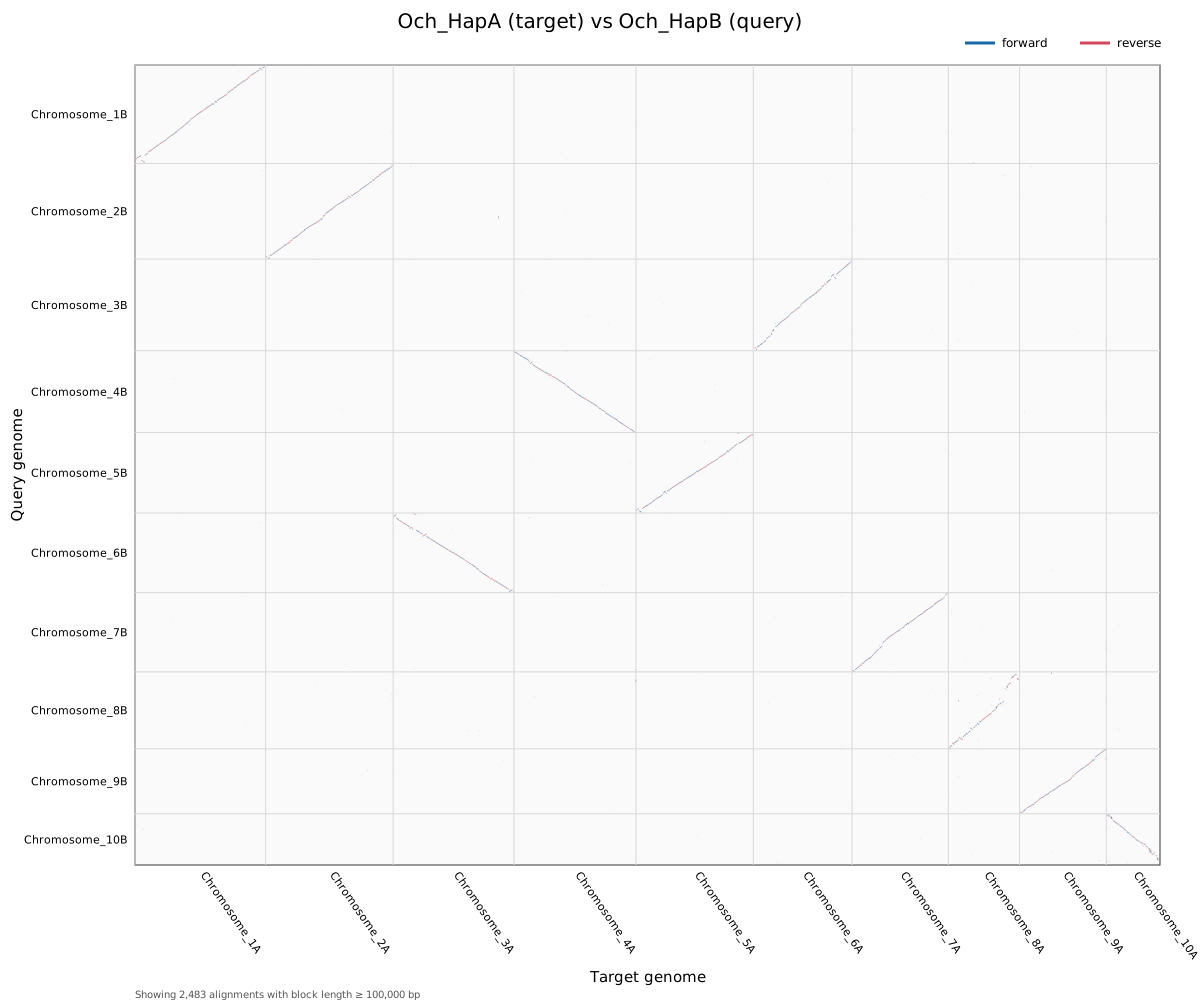
The two haplotype assemblies disagree about which chromosome is 3 and which is 6. They’re each internally consistent; the labels just got swapped between them. Every other chromosome pairs by number exactly as you’d expect (1A↔︎1B, 2A↔︎2B, …).
So Assembly 1.0 is fine biologically — all ten linkage groups are present, one sequence each. It picked HapA’s chr6 and HapB’s chr6, which are different chromosomes, and ended up with two sequences named 6 and none named 3. Anything that keys on chromosome name across these three files is going to be wrong for two chromosomes.
Dot plots
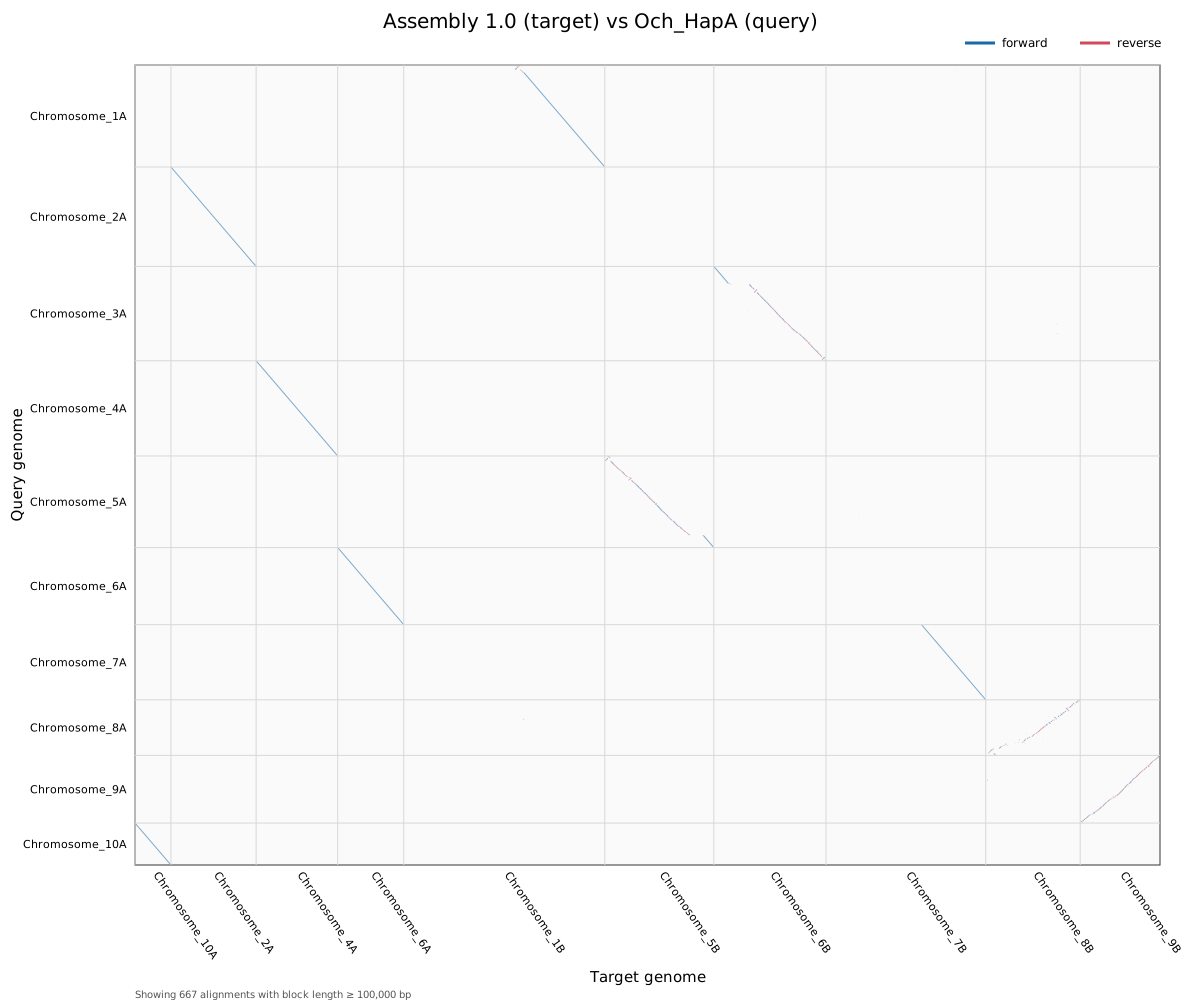
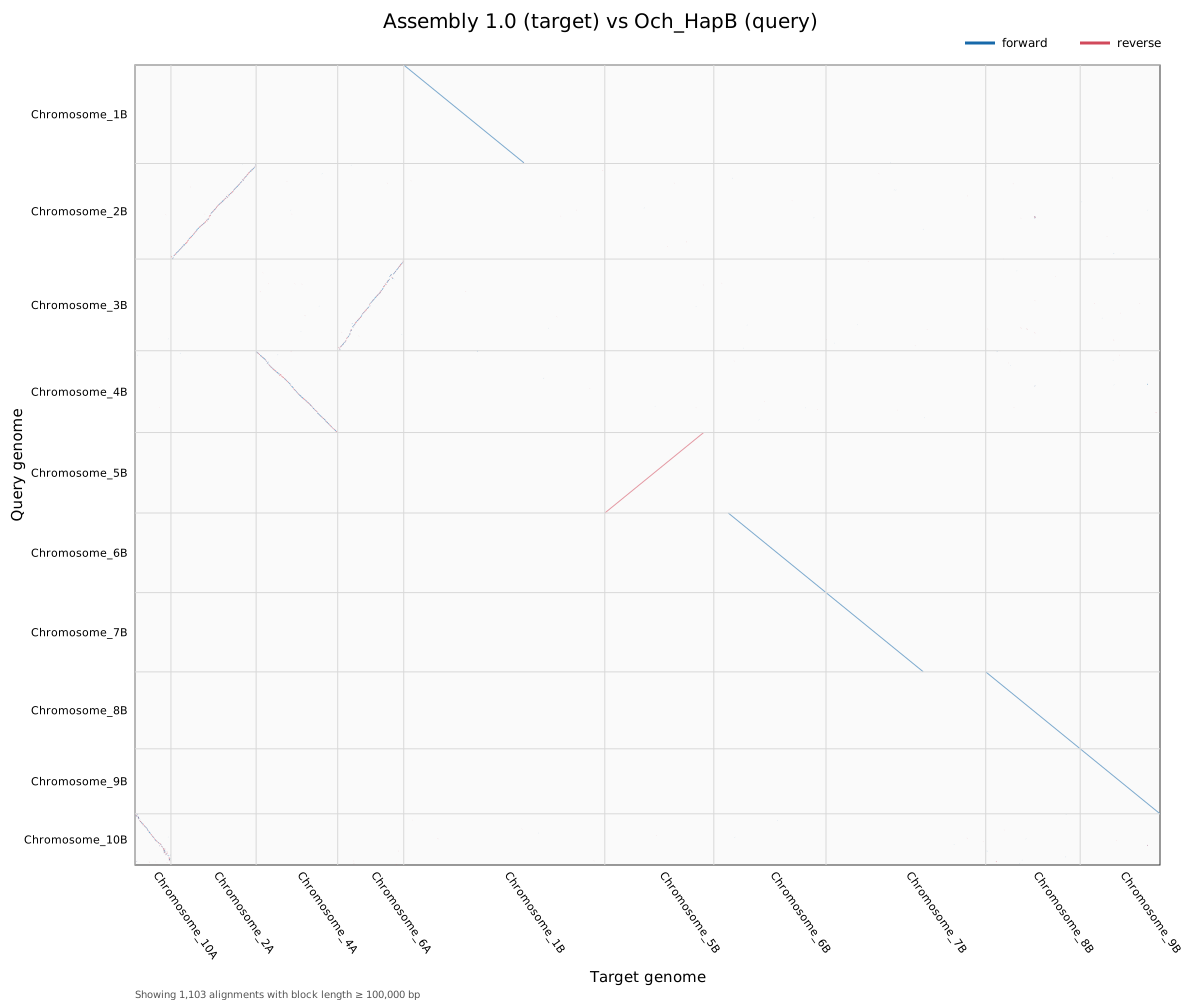
Hand-rolled SVG — cumulative offsets per sequence for both axes, one <line> per alignment, blue forward and red reverse, filtered to blocks ≥100 kb. No plotting library, which means no dependency and the output is a text file you can diff.
Assembly 1.0 vs HapA — clean. 667 blocks drawn. The near-diagonal segments are the four verbatim HapA chromosomes.
Assembly 1.0 vs HapB — 1,103 blocks. The stacked segments on Chromosome_1B and Chromosome_7B are the concatenated haplotypes.
HapA vs HapB — 2,483 blocks and a mess of red. The 3/6 swap is visible as the two off-diagonal blocks.
Caveats
-x asm5 is tuned for ~5% divergence. That’s the right preset for the near-identical comparisons, and too tight for HapA vs HapB — some of that 50,635-alignment fragmentation is the preset, not the biology. Worth a rerun at asm10/asm20 to see how much of it collapses.
The whole-comparison identity numbers (85.5 / 76.6 / 60.1%) are block-length weighted over everything, including short repeat hits, so they’re much less informative than the per-chromosome-pair rows in sequence_correspondence.tsv. Don’t quote the summary number.
And --secondary=no means each query region contributes one alignment, so the repeat-driven pileups (HapB 2B puts 116 Mb of blocks onto a 98 Mb sequence in both orientations) are coming from genuinely distinct query regions landing on the same target, not from reported secondaries.
Where this leaves the reference choice
Assembly 1.0 has the most complete sequence content but ~175 Mb of duplicated haplotype on chromosomes 1 and 7 and a broken chromosome naming scheme. HapA is the clean haploid representation at 790 Mb. HapB is 1.13 Gb and needs explaining before I’d trust it.
Next: quantify how much of the RNA-seq multi-mapping in the existing alignments falls on Assembly 1.0 chr1 and chr7, and rerun the cross-haplotype comparison at a looser preset.
Outputs
| File | What |
|---|---|
assembly_stats.tsv |
seq count, total bp, N50/L50, N90/L90 per assembly |
sequence_lengths.tsv |
every sequence and its length |
pairwise_summary.tsv |
one row per comparison — identity, coverage both directions |
sequence_correspondence.tsv |
query × target × strand, with matching and block bp |
input_manifest.tsv |
local paths, file sizes, source URLs |
alignments/*.paf.gz |
the PAFs |
logs/*.minimap2.log |
minimap2 stderr, including version and full command |
plots/*.svg |
the three dot plots |